Compare wheeled compact loaders by steering design, rated operating capacity, dimensions, lift geometry, auxiliary hydraulics and condition.


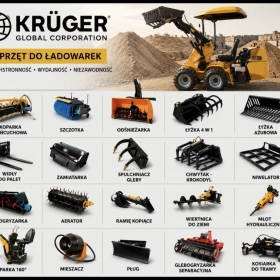
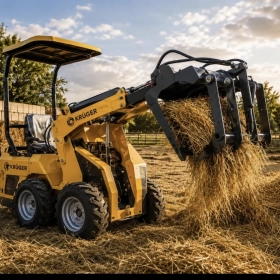

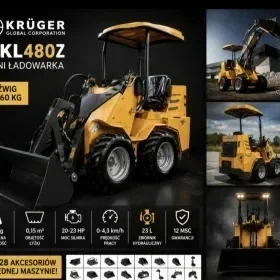
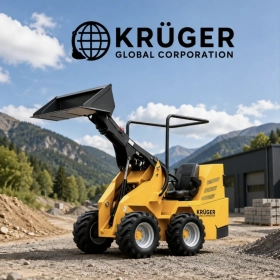
Miniładowarka KRÜGER XKL480Z | 560 kg | NOWY MODEL 2026 | 24 700 zł
Added: 14.09.2026, 08:17
None of the offers in “Mini loaders” fit?
Review the available offers and, if none fits, describe your requirements. Verified companies may respond after confirmation and moderation.
2 short steps. Clicking the button does not publish anything.
How to compare compact loader listings
This category covers wheeled skid-steer loaders and small articulated loaders. Machines on tracks belong in the separate track-loader category. Identify the steering design before comparing specifications, then match the machine to the surface, access width, required loading height and planned attachments. Compact is not a defined capacity class, so dimensions and performance data must be checked for the exact model and configuration.
Specifications that change what the machine can do
- Rated capacity and stability: compare rated operating capacity, tipping load and operating weight. Do not substitute a promotional maximum hydraulic lift figure. Establish which bucket, counterweight and machine configuration the data describes.
- Dimensions and manoeuvring: check width and height with and without the attachment, turning clearance, transport length and ground clearance. A skid-steer needs room to turn by skidding its tyres or tracks, while an articulated loader has a changing frame angle.
- Drive system and surface: a skid-steer and an articulated loader turn differently and place different loads on the surface. Compare the drive arrangement, tyre type and condition, ground clearance, turning behaviour and likely wear items.
- Lift path: a radial path generally provides more reach at intermediate heights, while a vertical path provides greater height and forward reach near the top. Match hinge-pin height, dump clearance and reach to the vehicle or container being loaded.
- Attachment hydraulics: verify auxiliary flow and pressure, standard-flow or high-flow capability, available circuits, unrestricted return, case drain and electrical controls where the attachment requires them.
- Coupler and tools: confirm the coupler interface, attachment weight and centre of gravity and what is included in the sale. Buckets, forks, grapples and augers can require different hydraulic capacity and alter machine stability.
What to inspect on a used compact loader
Ask for the identification plate, serial number, year, recorded hours, service history and previous applications. Check cold starting, warnings, smoke, travel in both directions and behaviour while turning. Inspect play at loader-arm, bucket and coupler pins, frame cracks or repairs, leaks around pumps, hoses and cylinders and operation of every hydraulic circuit. Look for uneven tyre wear, cuts and cracking, then check steering or articulation play and verify that every wheel drive responds correctly. Verify interlocks, restraint, protective structure and attachment compatibility. For a high-value purchase, consider an independent inspection and a controlled test under load.
Buyer FAQ
Is the term mini loader enough to compare two offers?
No. Identify the undercarriage, steering method and lift path first. Machines sold under the same broad label can have different manoeuvring behaviour, ground pressure, dump geometry and transport requirements.
How should a compact loader be matched to a hydraulic attachment?
Match the coupler interface, attachment weight and centre of gravity, required flow and pressure, high-flow requirement, return or case-drain line and electrical controls to the documentation for both products.
Which matters more, engine power or rated operating capacity?
They describe different limits. Power affects propulsion and simultaneous functions, while rated capacity and tipping load describe load handling for a stated configuration. They should be evaluated together with the attachment and working conditions.

 Log in with Facebook
 Log in with Google


