Over 7,000 people a year in Poland are injured in work-related accidents in the transport and warehousing sector. This is a number that should concern every manager responsible for safety. Even more alarming is the fact that 6 out of 10 accidents result directly from improper employee behavior. We’re not talking here about equipment failures or force majeure – we’re talking about mistakes that can be prevented.
According to data from the American agency OSHA, about 70% of forklift accidents could be avoided through better training and consistent adherence to procedures. This means that most dramatic events – from minor damage to fatal accidents – are not the result of bad luck but of predictable, recurring errors. In this article, we’ll show what these mistakes are, why operators make them, and what specifically can be done to avoid them.
What will you learn from this article?
- How often accidents occur
- The most common driving errors
- Why operators make mistakes
- The role of forklift technical condition
- The impact of environment and organization
- How to effectively prevent mistakes
The scale of the problem: forklift accident statistics
Before moving on to specific mistakes, it’s worth understanding the scale of the problem. Data from developed markets clearly show how common incidents involving forklifts are.
In the United States, it is estimated that there are 35,000-62,000 injuries annually related to forklift operation, with an average of 87 people losing their lives. This means that every 4 days someone dies in a forklift accident. If you run a warehouse with a fleet of 10 forklifts, statistics indicate that one of them will be involved in an incident during the year – according to data showing that about 11% of all forklifts are involved in accidents.
Forklifts account for about 25% of all transport-related workplace accidents and a similar percentage of all incidents in warehouse environments. This makes them one of the most hazardous elements of logistics work – right next to racking systems and loading platforms.
The most common type of incident is the overturning of a forklift, which makes up about 25% of all accidents. This category of event most often leads to the most serious injuries – crushing of the operator by an overturned forklift has a very high fatality rate. The second main cause of death is pedestrians being struck, accounting for 36% of fatal accidents.
The most important information? According to OSHA analyses, as much as 70% of these accidents could be avoided by implementing more effective training and consistent enforcement of safety procedures. This means we’re not talking about “unavoidable technical risks” – we’re talking about operational and organizational errors that can be prevented.
The most common mistakes while driving a forklift
Forklift operators make errors that can be grouped into several characteristic categories. Each has its consequences – from damage to goods, through downtime, to threats to life.
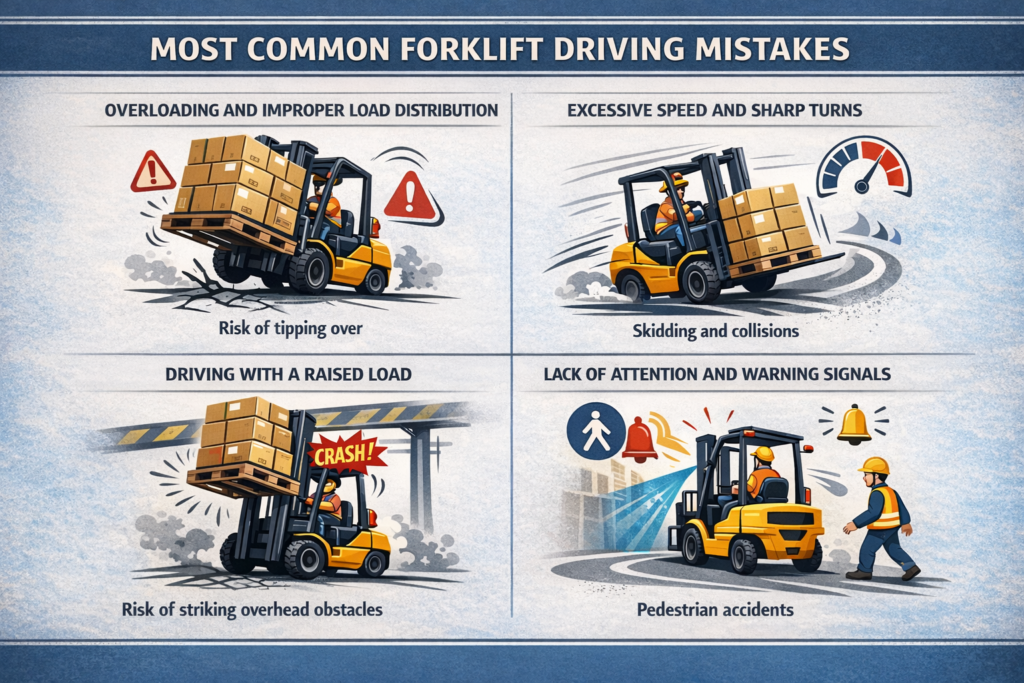
Overloading and improper placement of cargo
One of the most common mistakes is lifting loads that exceed the truck’s permissible capacity. This happens especially when the operator gets used to working with one truck and assumes every pallet “should fit.” The problem is exacerbated when the center of gravity shifts – for example, due to forks extended too far or lifting a load to a great height.
The nameplate on each forklift states its capacity, but only for standard configuration – usually with the load’s center of gravity at 500-600 mm from the vertical parts of the forks. When this parameter changes (greater distance, greater lifting height), the actual capacity drops dramatically. A 2000 kg load safely lifted to a height of 2 meters can be deadly at 4 meters high.
The consequences of overloading a forklift are primarily loss of stability and increased risk of overturning – the main cause of the most serious accidents. A falling load poses risks to both the operator and anyone nearby. In the case of a forklift overturning, the operator may be crushed by the machine or pinned by the load.
Excessive speed and aggressive driving style
Time pressure and the desire to get the job done quickly often lead to driving at excessive speeds, inappropriate for the conditions in the warehouse. Sudden braking, dynamic turns with a load, and forcing corners are common mistakes associated with haste.
Physics does not forgive mistakes – when turning, the forklift’s center of gravity shifts outward, and the risk of overturning grows exponentially with speed and load height. A 3-tonne forklift with a 1.5-tonne load traveling at 15 km/h needs much more space to turn safely than at 5 km/h. Sudden maneuvers also result in damage to warehouse infrastructure – shelving, gates, doors, and other forklifts.
The solution is electronic speed limiters and a clear principle: speed always adapted to the conditions. In narrow aisles, the maximum is 5 km/h; on ramps and near pedestrians – even slower. Driving too fast is not “efficiency” – it’s increasing the risk of accidents and faster equipment wear.
Driving with raised forks and load at height
Another common mistake is transporting with a load raised more than 50 centimeters above the floor. Operators sometimes lift the load “to put it away quicker” or drive with the mast lifted, leading to disastrous effects.
Driving with a load at height causes a drastic shift in the forklift’s center of gravity upwards, reducing its stability. Every bump, every turn becomes a potential tipping point. Additionally, a raised mast or load can snag on the building structure, installations, pipes, or beams – a common scenario in fatal accidents. Loss of visibility is another problem – a high load blocks the operator’s line of sight.
The golden rule: always transport with the forks lifted about 15 cm above the floor, with the mast slightly tilted back. This position ensures maximum stability and allows quick reaction in case of an obstacle. Any deviation from this rule increases the risk of the forklift overturning.
Failure to observe surroundings and improper signaling
Driving “by memory,” without continuously scanning the surroundings, leads to some of the most tragic accidents. Operators often don’t look in rearview mirrors, don’t observe blind spots, and don’t use audible signals in places with limited visibility.
The data are alarming: around 36% of fatal forklift accidents are pedestrian strikes. Warehouse workers moving on foot are often unaware of an oncoming forklift, especially when the operator fails to use the horn at corners or at gates. Rearview mirrors do not replace direct observation – when driving backwards, you must look in the direction of travel and not rely solely on the mirror reflection.
Prevention requires the creation of “zero tolerance zones” for lack of signaling – especially at corners, gates, and corridor junctions. Painting pedestrian crossings, installing barriers and shop mirrors, as well as pedestrian warning systems (e.g. blue LED lights projected in front of the forklift) significantly reduce the risk of accidents.
Working with unsecured and poorly arranged cargo
Loading uneven pallets with protruding elements, without straps or stretch film, is a mistake leading to cargo sliding off the forks during transport. Operators sometimes lift damaged pallets without assessing their durability, which may end with the pallet breaking apart during a maneuver.
Unstable cargo is not only a risk of material damage – it’s a risk to the operator and everyone in the warehouse. A falling box may not be fatal, but a falling 300 kg crate with metal parts can be. Additionally, a swaying load changes the weight distribution of the forklift, leading to loss of stability.
Warehouse standards should include procedures for assessing pallets before lifting – checking for damage, stability, and the need for extra security. Straps, stretch film, corner protectors and banding are not “unnecessary inconveniences” – they’re elements of correct work, preventing accidents and cargo damage.
Other common operational errors
Other frequent mistakes include: driving backwards using only rearview mirrors (instead of looking directly), not wearing a seatbelt in cab forklifts, improper seat and steering wheel adjustment (leading to quicker fatigue), turning on ramps and slopes perpendicular to the slope (instead of along it), and not adapting driving style to any special attachments mounted on the forklift.
Each of these mistakes can have serious consequences – from equipment damage through injury, to fatal accidents. The key is to understand that these are not “minor deviations from procedure” – they are behaviors that directly increase the risk of workplace accidents.
Why operators often make mistakes
Understanding the causes of mistakes is the first step to eliminating them. Operator mistakes rarely stem from pure irresponsibility – they more often result from a combination of ignorance, poor work organization, and psychological factors.
Ignorance and lack of training
Research on machine safety shows the key role of what specialists call “situational awareness.” This is the ability to continually monitor the environment, anticipate hazards, and make the right decisions in real time.
The data is clear: about 80% of human errors in the industrial work context are associated with lack of situational awareness – poor distance assessment, inattention, not noticing hazards, loss of concentration. In the case of forklift operators, this means situations where the operator does not notice a pedestrian, misjudges the space for maneuver, or fails to foresee that turning with a high load will cause a tip-over.
The problem is that one-off training without practice in real conditions does not build true competence. An operator may have theoretical knowledge of the nameplate, but if he has never practiced transporting different loads at different heights, he will not develop a “feel” for safe limits. Routine and “getting around” without periodic training lead to the development of bad habits.
On the other hand, data shows that good operator training can improve their safety outcomes by over 60%. Key elements of effective training include: working with real accident scenarios (videos, case studies), practical exercises in conditions similar to everyday work, and building the habit of “constant environment scanning.”
Human factors: fatigue, stress, and time pressure
Even the best-trained operator can make a mistake if fatigued, stressed, or working under time pressure. Studies show that fatigue and 12-hour shifts increase accident risk by about 37%. These are not small numbers – we’re talking nearly twice the probability of error.
Time pressure works similarly – when an operator knows he “has to make it,” he starts to cut corners, drive faster, skip checks. In such situations, the cognitive load (number of things to pay attention to simultaneously) increases dramatically: the operator must maneuver, watch for pedestrians, read labels, respond to instructions, and control the load. It’s a recipe for losing control of the situation.
Poor work organization aggravates problems – uneven workload distribution throughout the shift (quiet moments interspersed with shipping peaks), lack of breaks, unrealistic productivity standards. As a result, the operator “chases the norm,” and safety takes a back seat.
Routine and false sense of security
Paradoxically, experienced operators sometimes make more mistakes than beginners – due to routine and overconfidence. An operator who has “driven down the same corridor with a high load thousands of times and nothing ever happened” stops seeing the risk. This psychological phenomenon is known as “normalization of deviation” – hazardous behavior becomes the norm because “we’ve always done it this way.”
A false sense of security leads to ignoring procedures, skipping pre-operation checks, driving a faulty forklift “because I’ll deal with it soon.” Every such deviation increases the probability of an accident, but as long as nothing happens, the behavior becomes reinforced.
How the technical condition of the forklift affects errors
Operators often make operational mistakes, but a significant part of problems results from neglected technical condition of forklifts. Faulty equipment is not only a threat itself – it also provokes operator mistakes as they try to compensate for deficiencies.
Faulty brakes and hydraulic system
Extended stopping distances due to worn pads or poorly adjusted brake system mean the operator can’t maintain a safe speed. Knowing the forklift “doesn’t brake well,” an experienced operator will drive slower – but in an emergency (e.g. a pedestrian entering the way), there may not be enough distance to stop.
Hydraulic leaks are another issue leading to unstable lifting and sudden load drops. The operator loses precise control over the mast, which can result in damage to goods or racking structures when working at height. Worn tires provide poor traction – forklifts skid on turns, especially on smooth warehouse floors.
The problem is that technical degradation often occurs gradually, and the operator may not realize how much the risk increased. What was acceptable yesterday may cross the safety threshold today – but without a clear breaking point, it’s hard to notice.
Problems specific to electric forklifts
Electric-powered forklifts have their own specific failures. Incorrect battery charging (too short, too long, at the wrong temperature) reduces battery life and can lead to sudden power loss at a critical moment – for example, when the operator has a load lifted 4 meters high.
Damaged cables, neglected battery, corroded contacts – all can cause a breakdown when least expected. Operators working with electric forklifts also need to consider specific hazards during charging – lead-acid batteries can emit explosive hydrogen, so charging requires proper location, ventilation, and use of personal protective equipment.
Lack of daily pre-operation checks
The basis of safe operation is a daily check of the technical condition before a shift. Checking tires, forks, mast, brakes, lighting and sound signals, and leaks takes 5-10 minutes, but can prevent serious failure.
In practice, these checks are often skipped – due to time pressure, lack of awareness of their importance, or a weak operational culture in the company. The operator takes over the forklift from the previous shift and assumes “everything’s OK” without checking it personally. As a result, a minor defect detected in the morning could have been fixed before work began – but if undetected, it leads to breakdown during the workday.
It is also crucial to understand that the operator has the right and obligation to refuse to work with a faulty forklift. Any noticed defect should result in immediate reporting and taking the machine out of service until repaired. The culture of “it’ll get by” is a straight path to a serious accident.
Neglected technical inspections and maintenance
Poor service culture – saving on inspections, postponing repairs, lack of clear responsibility for fleet technical condition – is a systemic problem in many warehouses. Managers sometimes treat inspections as an “unnecessary expense,” not realizing that the cost of breakdowns and downtime is many times higher than the cost of preventive maintenance.
Regular inspections in accordance with the manufacturer’s recommendations, fluid replacement, monitoring of critical wear elements (brake pads, mast chains, tires) are not luxuries – they are the foundation of safe and efficient work. A forklift needs proper care, and neglect quickly leads to technical problems escalating and an increased risk of accidents.
The influence of the work environment and warehouse organization
Even the best-trained operator working with a functional forklift can make a mistake if the work environment is poorly organized. External factors have a huge impact on accident probability.
Inadequate warehouse infrastructure
Overly narrow aisles are a fundamental problem – if the aisle width barely exceeds the width of the forklift with its load, maneuvering becomes extremely difficult, and even a slight deviation from the course risks hitting the rack or wall. The minimum aisle width should be the forklift’s width plus at least a 1-meter margin.
Poor lighting, blind spots with no mirrors, turns with no visibility are other factors increasing operator cognitive load. Lack of barriers protecting pedestrian zones, disorganized storage areas, cluttered passageways – all force the operator to pay extra attention and make makeshift maneuvers, dramatically increasing the risk of forklift overturns or pedestrian collisions.
Remember that 25% of all warehouse accidents are related to forklifts – good warehouse space organization is not a cost, it’s an investment in safety and operational efficiency.
Mixed traffic of pedestrians and forklifts
The statistics are brutal: 36% of deaths in forklift accidents are pedestrian strikes. In most cases, the cause is lack of traffic separation – employees walk in the same aisles as forklifts, with no marked pedestrian crossings or physical barriers.
Pedestrians are often unaware of the forklift operator’s limited field of view, especially when the forklift is driving backward with the load blocking the view forward. Additionally, electric forklifts are very quiet – a worker may not hear an approaching vehicle. Clearly marked forklift routes (e.g. yellow lines on the floor), pedestrian crossings, physical separation (barriers, gates), and mirrors at blind turns are basic elements of a safe infrastructure.
Organizational pressure and uneven workload
Organizational problems directly affect operator behavior. Uneven workload – long idle times interspersed with peak times when “you have to make it” – leads to haste and skipping procedures. Chasing targets without considering conditions (e.g. narrow passages, difficult cargo, faulty equipment) creates pressure that leads to mistakes.
Lack of time for proper safety procedures (pre-shift checks, securing loads, proper driving pace) is a systemic issue requiring intervention on the management level. A manager demanding “faster” without ensuring safety is, in effect, encouraging rule-breaking.
How to effectively prevent operator errors
Knowledge about mistakes and their causes is only half the battle. The key is to implement systemic solutions that truly reduce the risk of accidents. Below we present the four pillars of effective prevention.
Pillar 1: Training and building situational awareness
The foundation of safety is training – but not just one-time instruction, but a system of introductory and periodic training, at least once a year. Data shows clearly: quality training can improve safety indicators by over 60%. That’s a huge difference from one action.
Effective training must include real accident scenarios – warehouse video footage, specific case analyses, showing the consequences of mistakes. A dry lecture on “OHS rules” does not work – the operator must SEE what happens when someone takes a corner too fast with a high load. Practical exercises are the second key element: maneuvering in narrow aisles, working with different types of loads, simulating typical mistakes (e.g. trying to lift loads above the capacity) in controlled conditions.
The third element is working on situational awareness – the principle of “constant scanning” of the environment, recognizing special risk zones (corners, gates, corridor junctions), prioritizing pedestrian safety. The operator must develop a habit of continuous observation, rather than relying on memory and routine.
Pillar 2: Procedures and strict operational discipline
The best training does not replace clear, enforced procedures. Every operator should have a daily checklist before starting work: checking tires, forks, mast, brakes, lighting and sound signaling, and checking for oil or hydraulic fluid leaks. This check takes 5-10 minutes but detects most dangerous defects.
Hard and fast rules with no exceptions are the foundation of safety: no driving with the load lifted more than 15 cm above the floor, absolute ban on transporting people on forks, speed limits adapted to the zone (narrow aisles max 5 km/h, ramps 3 km/h), no work with a faulty forklift – no “it’ll get by”.
The defect reporting system is also key: every noticed problem must result in immediate withdrawal of the forklift from service and reporting to the service department. No reprisals for reporting problems – the operator must not be afraid that “he’ll be in trouble” if he finds a defect. On the contrary – he should be rewarded for vigilance.
Pillar 3: Infrastructure and organization of warehouse space
Good procedures are not enough if the work environment itself provokes mistakes. Clearly marked forklift routes (yellow or white lines on the floor), pedestrian crossings (clearly color-marked), physical separation of pedestrian and forklift traffic (barriers, gates) are the minimum requirements for a safe warehouse.
Mirrors at blind turns allow the operator to see an approaching forklift or pedestrian. Appropriate lighting of loading and unloading zones (minimum 300 lux) eliminates dead zones and improves visibility. Eliminating chaos is another crucial element – fixed storage locations, tidy aisles, no “temporary” pallets blocking passageways.
Infrastructure standards can be specified specifically: aisle width at a minimum of truck width + 1 meter, passage height at least mast height at maximum extension + 20 cm clearance, height markings visibly placed before each gate.
Pillar 4: Technologies supporting safety
Modern operator assistance systems (ADAS – Advanced Driver Assistance Systems) are becoming increasingly accessible and effective. Proximity sensors warn of pedestrians or obstacles in blind spots. Cameras (especially at the back of the forklift) improve visibility when reversing. Speed control systems automatically limit the maximum speed in certain warehouse zones.
Pedestrian warning systems – for example, blue or red LED lights projected onto the floor in front or behind the forklift – increase the forklift’s visibility for nearby people. Studies show that well-designed support systems help compensate for visibility limitations and reduce the operator’s cognitive load, allowing them to focus on key tasks.
Technologies are an additional line of defense against error – they don’t replace training and procedures, but significantly increase the safety margin.
Summary
Mistakes made by forklift operators are not the result of “bad luck” or “inevitable accidents” – they’re predictable, recurring behaviors that can be effectively prevented. The data is clear: forklifts account for 25% of warehouse accidents and a similar share of workplace transport accidents, but around 70% of these incidents could be avoided through better training and consistent procedure compliance.
The most common mistakes: overloading and improper cargo arrangement (main cause of overturns), driving at excessive speed and aggressive maneuvers, transport with raised forks, lack of observation (36% of deaths are pedestrian collisions), and working with unsecured loads. Each of these errors has deep-rooted causes: 80% of human mistakes result from insufficient situational awareness, fatigue increases risk by 37%, and routine leads to normalization of dangerous behaviors.
The technical condition of the forklift is crucial – worn brakes, hydraulic leaks, worn tires are not only dangerous on their own but also provoke operator errors. An operator compensating for equipment malfunctions makes risky decisions. External factors are equally important: narrow aisles, poor lighting, no separation of pedestrian and forklift traffic, time pressure – all these increase the probability of an accident.
The recipe for safety is based on four pillars: training to build situational awareness (effectiveness +60%), strict adherence to procedures and operational discipline, proper warehouse infrastructure, and modern technologies supporting the operator. Most mistakes are not due to “bad luck” but to things that can be consciously designed, monitored, and systematically improved. This requires engagement at every level – from operators, through supervisors, to management – but the result is worth it: a safer workplace, fewer accidents, lower downtime costs, and higher efficiency of the entire warehouse operation.
See ads in the forklifts category →